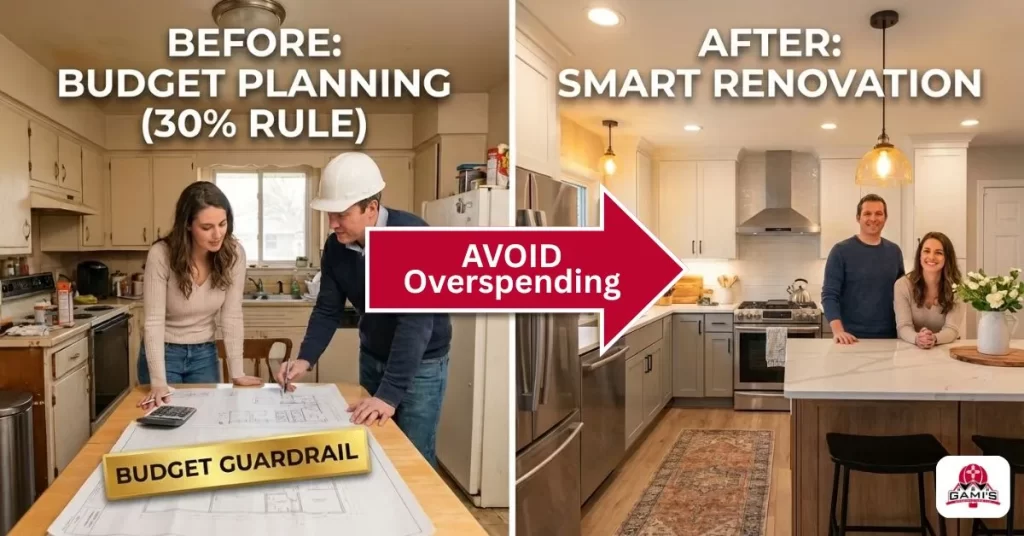
Home renovation is exciting… right up until the numbers start creeping. A bigger tile upgrade here, “just one more” cabinet feature there, and suddenly you’re in the middle of remodel decisions that don’t match your bank account.
That’s where the 30% rule home renovation guideline helps. It’s a simple way to set a budget guardrail so you can renovate with confidence, protect resale value, and avoid the “we didn’t see that coming” financial stress—whether you’re planning a kitchen renovation, bathroom renovations, or home additions.
What the 30% rule home renovation really means
The 30% rule is a budgeting guideline that says: try not to spend more than ~30% of your home’s current market value on a major renovation scope. It’s meant to prevent over-improving (spending far beyond what your home and neighborhood can realistically support).
Two important clarifications:
- It’s not a hard law. It’s a planning tool—especially helpful when you care about resale value, ROI, and staying financially comfortable.
- It works best as a “cap + framework.” Instead of treating it like one big number, you use it to set boundaries, then build a realistic plan underneath.
If you’re searching “home restoration near me” because you’re dealing with damage, safety issues, or major repairs, the 30% rule still helps—but you may need to prioritize must-fix items first (more on that below).
Step 1: Find your home’s true market value (not a guess)
The entire rule depends on one thing: a realistic home value. Online estimates can be wildly off—sometimes enough to derail your plan.
Here are better options, in order of accuracy:
- Recent comparable sales (“comps”) in your neighborhood (a local agent can pull these quickly).
- A professional appraisal (best for major projects or if you’re considering financing).
- Multiple reputable estimates (use 2–3 sources and average them if you can’t access comps).
Once you have a realistic number, multiply it by 0.30.
Example: $350,000 home value × 0.30 = $105,000 total renovation ceiling.
Step 2: Translate 30% into a room-by-room budget
A common mistake is treating the 30% number like one bucket of money. A smarter move is to allocate it by priority, ROI, and impact.
A practical way to split your budget
Use a simple “zones” approach:
- Kitchen remodel contractors scope: often the biggest ticket because of cabinets, labor, and mechanicals.
- Bathroom renovations: typically smaller per room, but multiple baths add up fast.
- Home additions: can be expensive quickly because they involve structure, permits, foundation/roof ties, and mechanical extensions.
- Whole-home refresh: paint, flooring, lighting, minor layout improvements, and repairs.
Sample allocation (adjust to your home)
If your 30% cap is $105,000, a balanced plan might look like:
- Kitchen renovation: $35K–$55K
- Bathroom renovations near me (1–2 baths): $15K–$30K
- Home improvement services (flooring/paint/lighting/repairs): $15K–$25K
- Contingency + permits + design: $10K–$20K
That’s not a quote—it’s a planning model. Your actual home renovation costs depend heavily on scope, finish level, and what’s behind the walls.
Quick “sanity check” questions
Before you lock anything in, ask:
- Are we solving the biggest daily pain points?
- Are we upgrading for function, or mostly for aesthetics?
- Will this plan still feel comfortable if costs rise 10–15%?
What to include and exclude in your renovation budget
To make the rule useful, you need a clean definition of what counts as your “renovation budget.”
Include (most homeowners underestimate these)
- Labor + materials (the obvious stuff)
- Permits, inspections, and plan reviews
- Demolition, disposal, and site protection
- Electrical/plumbing/HVAC changes
- Structural work (beams, walls, framing)
- Project management + scheduling coordination
- Finish materials (cabinets, tile, flooring, fixtures)
- Delivery fees + lead-time upgrades
- Temporary living costs (if parts of the home are unusable)
Exclude (track separately so you don’t blow the budget)
- Furniture and décor (often a separate line item)
- Small accessories you’ll buy over time (rugs, art, styling)
- Optional tech upgrades that aren’t part of the build scope
If you’re planning a home for renovation with multiple rooms, separating these categories prevents you from thinking you’re “on budget” while your credit card quietly disagrees.
You can also read: How Much Does It Cost to Renovate a House?
Add a safety net: contingency, allowances, and “scope creep” rules
Even well-planned home renovations can get hit with surprises—especially in older homes.
The contingency buffer (non-negotiable)
Set aside 10–20% of the construction budget as contingency. This is your “unknowns” money—rot, outdated wiring, plumbing surprises, subfloor issues, or code upgrades you didn’t anticipate.
Allowances (where budgets go to die)
Allowances are placeholders for items you haven’t selected yet (tile, fixtures, lighting, appliances). If your allowances are too low, your budget will “look fine” until selections start.
Fix: For every allowance category, decide:
- “Budget / mid / premium” target
- A realistic price range
- A decision deadline (so the project doesn’t stall)
A simple scope-creep rule that works
Before adding anything new, ask:
- Does it improve function, safety, or durability?
- Will it matter in 12 months?
- What are we removing or downgrading to fund it?
If you can’t answer #3, it’s probably a “nice-to-have” you should postpone.
Prioritize for ROI: avoid over-improving and protect resale value
The biggest reason the 30% rule exists is resale math. Not every dollar you spend comes back when you sell.
A good benchmark is the annual Cost vs. Value style reporting that compares remodel costs to resale value impact across U.S. markets.
Where homeowners usually get the best “value-to-impact”
- Fixing what buyers notice first: worn flooring, old paint, bad lighting
- Kitchens that are functional, durable, and easy to maintain (not necessarily luxury)
- Bathrooms that feel clean, updated, and problem-free
- Curb appeal and exterior maintenance (first impressions matter)
The “neighborhood match” principle
If every nearby home has laminate counters and basic tile, installing ultra-premium finishes may not raise your sale price enough to justify the spend. The sweet spot is upgrading to the top of your local market—not beyond it.
Financing options and how they affect your budget
Many homeowners fund renovate projects through some mix of savings + financing. If you’re comparing home improvement loan rates, focus on total cost and risk, not just the monthly payment.
Common options:
- Savings/cash: simplest, but don’t drain your emergency fund.
- Home equity line of credit (HELOC): flexible borrowing against equity, but it uses your home as collateral and has real risk if payments become unmanageable.
- Home equity loan: lump sum, often fixed payment structure.
- Limited FHA 203(k): can allow financing home improvements into a mortgage structure (rules and limits apply).
- Contractor financing: convenient, but compare APR and fees carefully.
Smart move: Decide your “comfort zone” payment and keep your project scope inside that—rather than expanding the scope because financing is available.
Hiring home reno contractors: how to compare quotes and stay on track
If you’re searching “home remodeling contractor,” “home renovators near me,” or “builders near me,” here’s how to avoid the #1 trap: comparing apples to oranges.
Get bids based on the same scope
Ask each remodeling contractor to price the same:
- Scope of work (what’s included and excluded)
- Material level (budget vs mid vs premium)
- Allowances (tile, fixtures, cabinets, etc.)
- Timeline assumptions
- Permits and inspections responsibility
Red flags that lead to budget pain
- Vague line items like “miscellaneous”
- Missing allowances (or unrealistically low ones)
- No plan for change orders
- No clear payment schedule tied to milestones
Make the project easier to control
Before work begins, you should know:
- Your top 3 priorities (function, resale, layout, durability, etc.)
- Your “do not cross” budget number
- What you’ll postpone if costs rise
This is what “honest renovations” look like in real life—clear scope, clear decisions, no mystery math.
Common mistakes + when it’s smart to break the 30% rule
Mistakes that blow up home renovation costs
- Starting demo before selections are finalized
- Upgrading everything instead of prioritizing pain points
- Underestimating labor, permits, and lead times
- Skipping contingency (“we’ll handle surprises later”)
- Changing layouts without understanding structural/mechanical impact
When going over 30% can be reasonable
Sometimes “home restoration” or required upgrades justify higher spend:
- Safety issues (electrical hazards, mold, failing plumbing)
- Structural repairs (foundation, framing, roof problems)
- Code-required updates triggered by the project
- Accessibility needs for aging-in-place
- A forever-home decision where lifestyle value matters more than resale
If you do exceed the guideline, do it intentionally: document the reasons, confirm you can afford it comfortably, and avoid stacking multiple high-cost upgrades at once.
FAQs
No—think of it as a guardrail. It helps prevent overspending and supports better resale decisions, but your priorities (safety, lifestyle, long-term plans) still matter.
Usually no. Track furniture, décor, and move-in styling separately so they don’t quietly inflate your renovation budget.
It depends on scope and finishes. A smart approach is setting a kitchen remodel price range that fits your total cap and your neighborhood’s market—then designing within it.
Reduce scope, phase the project, adjust finishes, or redesign for efficiency before you commit. “Value engineering” early is far cheaper than changing mid-build.
Home additions often require more structural, mechanical, and permit work than interior remodels. Treat additions as their own budget bucket and keep a larger contingency.
Compare scope, allowances, exclusions, timeline, and change-order rules—not just the total number.
Conclusion: Plan smart, renovate confidently
The 30% rule is simple—but it’s powerful when you use it as a system: real home value → smart cap → room-by-room priorities → realistic allowances → contingency → controlled decisions.
If you’re planning home renovations and want a budget that matches your goals (and doesn’t spiral), Gami’s Constructors LLC can help you translate your ideas into a clear scope, realistic costs, and a build plan you feel good about. Reach out to request a quote or schedule a consultation to talk through options before you commit.