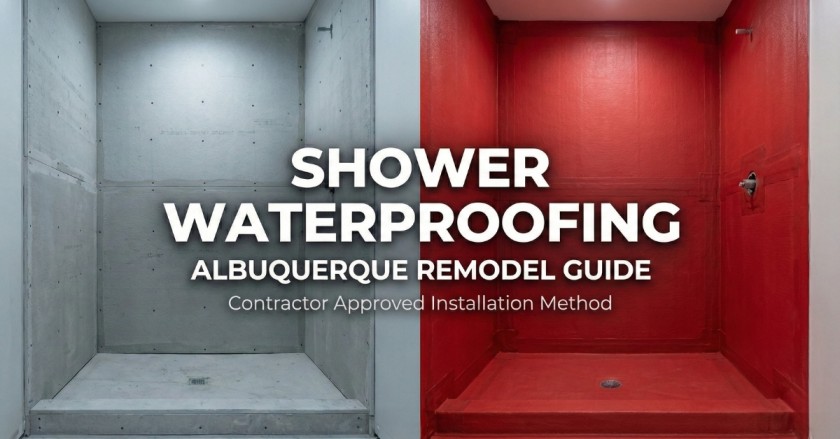
If you’re planning a bathroom remodel in Albuquerque, NM, learning how to waterproof a shower is one of the smartest things you can do—even if you’re hiring it out. Tile looks solid, but water doesn’t stop at the surface. Grout and thinset aren’t waterproof, so without a real shower waterproofing plan, moisture can work its way into walls, subfloors, and framing before anyone notices.
How to waterproof a shower: the pro sequence that prevents leaks
Think of waterproofing as a system, not a product. The order matters, and skipping steps is where problems start.
Step 1: Demo + inspection (what we look for)
- Rotten or soft subfloor, loose studs, moldy insulation
- Out-of-plumb framing (common in older Albuquerque homes)
- Drain type, location, and plumbing condition (cast iron vs ABS/PVC)
Step 2: Build the slope before you “seal”
Water must move toward the drain. Waterproofing can’t compensate for a flat floor.
Step 3: Choose a full shower waterproofing system
Pick sheet membrane, liquid membrane, foam board system, or a traditional liner—then stick to compatible parts (drain, corners, sealants, thinset).
Step 4: Waterproof the pan + drain connection first
Most shower leaks begin at the pan and drain transition, not mid-wall.
Step 5: Waterproof walls + all the “details”
Corners, seams, niches, benches, valves, pipe penetrations—these are the weak points.
Step 6: Quality checks
Membrane thickness (for liquids), seam coverage (for sheets/boards), and a flood test when the assembly allows it.
Start with the structure: slope, framing, and backing matters
Before any waterproof membrane for shower goes up, the structure needs to be right:
- Framing: Straight, solid, and properly blocked at pan/liner height.
- Backer choice: Cement board or foam boards are common in wet areas; regular drywall is not the right choice for most showers.
- Gaps & transitions: Leave manufacturer-required gaps at board joints and transitions so movement doesn’t crack tile or seams later.
In Albuquerque, we also plan for real-life use: daily showers, temperature swings, and hard-water buildup—because tiny cracks and weak corners don’t stay tiny forever.
Choose your shower waterproofing system (sheet vs liquid vs foam-board)
There are three modern “families” of systems you’ll see on professional jobs:
Sheet membranes (bonded)
A shower waterproofing membrane in sheet form gets bonded to the walls/pan and sealed at seams. Advantages: consistent thickness and no cure time; seams are typically overlapped and banded per manufacturer instructions (often around a couple inches).
Liquid-applied membranes
A paint-on liquid waterproofing membrane for cement board that cures into a rubbery barrier. Advantages: great for odd shapes, niches, and transitions—but only if applied to the correct thickness and allowed to cure.
Foam wallboards + integrated pans
These are waterproof at the surface, lightweight, and fast to install—but the system only works if seams, fasteners, and corners are sealed correctly.
Contractor takeaway: In Albuquerque remodels, we often choose based on (1) shower design complexity, (2) timeline, (3) drain/pan approach, and (4) how many seams/penetrations we need to protect.
You can also read: How Much Does It Cost to Renovate a House?
Waterproofing the shower pan and drain transition (where most leaks start)
If there’s one area we treat like “surgery,” it’s the pan.
Common approaches
- Bonded sheet membrane + bonding flange drain (often paired with a pre-sloped pan or mud bed)
- Foam pan system (pre-sloped base + matching drain + seam banding)
- Traditional liner + mud bed (older method that can still work when built correctly)
Important watch-out (especially for DIY)
Some liquid products are widely used on walls, but should not be relied on as the only waterproofing for a shower pan that needs to be sloped and flood-tested—this is where full-system methods are typically safer and more inspection-friendly.
Details that separate “looks good” from “holds up”
- Proper slope to drain (no birdbaths)
- Correct curb build + waterproof outside corners
- No clogged weep paths (in traditional methods)
- Clean drain connection with compatible sealants/adhesives
Waterproofing shower walls, corners, niches, benches, and penetrations
This is where most failures hide—because it’s all behind the tile.
High-risk areas we always detail carefully
- Inside corners / plane changes
- Seams between boards
- Valve and shower head penetrations
- Niches and benches (water sits here, so the waterproofing must be continuous)
- Tub-to-shower conversions (transition details matter at the former tub deck/ledge)
For liquid systems, it’s common to reinforce joints/corners/transitions with mesh or fabric when the manufacturer calls for it.
For foam boards, every seam and fastener needs approved sealant or banding so water can’t sneak behind the surface.
Liquid membrane details (Hydro Ban vs RedGard) and why thickness matters
Homeowners often ask about Hydro Ban vs RedGard because both are popular liquid options.
Here’s the practical difference from the field:
- Liquid membranes work when you hit the required wet mil thickness, coat coverage, and cure time.
- Pros use a wet film gauge because “it looks covered” is not a measurement.
- Many liquid systems require at least two coats and full curing before tile.
Some rapid-curing liquids can allow flood testing after about a day when installed to spec—but the exact timeline depends on temperature, humidity, and manufacturer requirements.
Don’t forget the floor: waterproofing bathrooms beyond the shower
Even outside the enclosure, bathrooms see water at:
- The shower entry
- Toilet supply line area
- Vanity plumbing
- Kids + pets + daily splashes
Waterproofing the bathroom floor (especially near the shower) adds protection for the subfloor and reduces the odds of hidden damage later.
Quality control that protects your remodel: flood tests and checklists
When the assembly allows it, a flood test is one of the cleanest ways to verify a pan is sealed before tile.
What we’re checking:
- No drop in water level over the test period
- No leaks at the drain flange, corners, curb transitions, or penetrations
- Seams/corners fully bonded with no voids
In Albuquerque, we also keep an eye on jobsite conditions: temperature, dust control, and dry-time realism—because rushing membrane cure is a common cause of failure.
What to ask your Albuquerque contractor before work starts
If you’re comparing bids in Albuquerque, ask these (you’ll learn fast who’s detail-oriented):
- Which shower waterproofing systems do you use—and why for my layout?
- What’s your plan for the shower pan, curb, and drain transition?
- How do you waterproof niches/benches and valve penetrations?
- If using liquid membrane: how do you confirm wet mil thickness?
- Will you waterproof the bathroom floor outside the shower?
- Will the pan be tested before tile (when possible)?
- What parts are from the same manufacturer system (membrane, drain, corners, sealant)?
Next Steps Checklist
- Decide on shower type: tile shower, tub-to-shower conversion, curbless, etc.
- Pick the system family: sheet, liquid, foam-board, or traditional liner
- Confirm pan strategy + drain type (and whether a flood test is planned)
- Plan for niches/benches/penetrations before the first board goes up
- Make sure the bathroom floor protection is included, not “optional later”
- Get the scope in writing (products, steps, and quality checks)
FAQs
Start by fixing framing and slope, install cement board or foam boards, waterproof the shower pan and drain connection first, then waterproof walls, seams, corners, niches, and penetrations. Finish with a flood test (when possible) before tile.
It depends on the shower design and installer skill. Sheet membranes give consistent thickness and fast tiling, while liquid membranes work well for complex shapes but must be applied at the correct thickness and fully cured.
RedGard is commonly used on shower walls, but a shower pan usually needs a full pan-rated system (with the right drain connection and slope). Many failures happen when liquids are used without the correct pan method.
Corners and seams are sealed using approved seam tape/banding (for sheet/foam systems) or reinforced fabric/mesh (for many liquid systems). These areas are major leak points if rushed.
Most projects take 1–3 days for waterproofing work depending on the system. Liquid membranes can add extra time because you must wait for proper cure before tiling or testing.
Cost varies based on shower size, pan type (pre-sloped vs custom), number of niches/benches, and the system used (sheet/liquid/foam-board). More corners and custom details usually increase labor cost.
In many remodels, yes—especially near the shower entry and toilet/vanity plumbing. It adds an extra layer of protection against splashes and future leaks.
A clean-looking shower isn’t the same as a protected one. If you want fewer surprises during your remodel, focus on systems, sequencing, and the small details—pan transitions, corners, penetrations, and cure times. And if you’d like a pro to walk your space and explain options, Gami’s Constructors can help you plan a shower upgrade in Albuquerque, NM with practical, code-aware detailing and clear scope—so you feel confident before tile day.
This content is for general information; project requirements vary.
Ready to get started? Visit Gami’s Constructors at gamisconstructors.net and request a bathroom remodeling consultation.